

Water-Saving Techniques for Banana Farmers
Introduction
Bananas are an important product for India. India is the world’s largest producer of bananas, accounting for roughly 20–27% of global banana production in recent years.
Indian bananas are exported mainly to the Middle East, much of Asia, and some parts of Russia. This makes bananas a very important cash crop for Indian farmers. Bananas are grown extensively in Tamil Nadu, Maharashtra, Karnataka, Gujarat, and Andhra Pradesh, among other states, in tropical and subtropical climates. Bananas are a quick-growing crop, ready for harvest within a year, produce robust harvests each cycle and, best of all, are highly profitable.
However, bananas are among the more water-demanding crops. Their cultivation requires considerable quantities of water, and extensive production can result in substantial overall water consumption. . A single banana plant can use 1000 to 1400 mm of water per year, and with the growing challenge of water scarcity in agriculture, ensuring this level of irrigation throughout the banana plant's growth is not easy. Since bananas are an excellent export product, not growing them is not an option. Rather, having a way to reduce water wastage and increase water efficiency is more valuable and something that banana farmers are always looking for.

Understanding Water Needs of Banana Plants
- Typical water requirements at different growth stages : A banana plant has four stages of growth, which require different amounts of irrigation to grow into healthy plants. The first stage is the vegetative stage, when the plants are planted in the soil, and they grow root stem and leaves and the body of the plant, and this stage needs the least amount of irrigation of the other stages. The vegetative stage is followed by the pre-flowering and flowering stages, during which irrigation needs increase consecutively. The water is tapered off at the end of growth just before harvest.
- Effects of overwatering vs. underwatering : Since bananas grow only a fibrous stem and overlapping leaves, it needs a consistent amount of water for growth, but too much water will lead to the plants rotting and dying off. Overwatering will for sure kill the plants, and so will poor drainage. Underwatering or irrigating below the plant’s needs will lead to low fruit filling, and the end harvest will be a collection of low banana bunch weight and small bananas.
- Soil type and climate considerations : Bananas favour loamy soil and variations of loamy soil, such as sandy loam or clay loam, since it is easier to spread in this type of soil. This kind of soil is not too tightly packed, which encourages banana plant growth. They also tend to do better in subtropical and tropical regions, with high rainfall and sunlight. There are only a limited number of areas in the country that support this kind of soil with these climate considerations, but the places that do can grow bountiful yearly banana harvests.
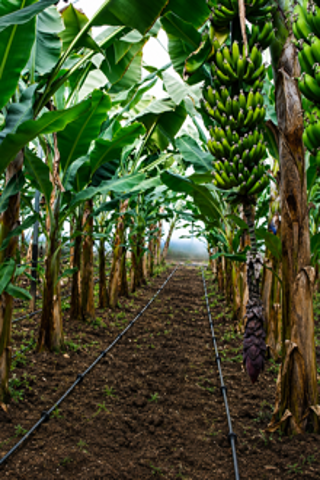
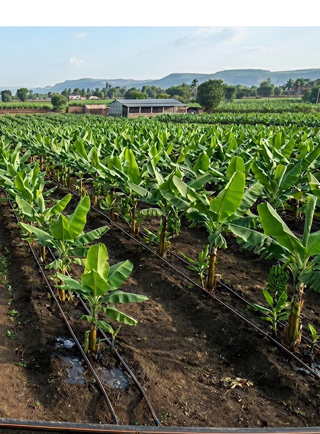
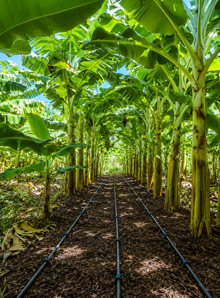
Drip irrigation is an efficient watering method that uses a network of pipes, valves, emitters, and filters to deliver water directly to the root zone of plants. In banana cultivation, lateral pipes are often laid on or beneath the soil surface, allowing water to reach the roots with minimal losses from evaporation and runoff. By supplying water at a controlled rate and in precise amounts, drip irrigation ensures that plants receive the moisture they need for optimal growth. This targeted approach not only conserves water but also reduces weed growth, improves nutrient uptake, and can lead to higher yields. Although the initial installation costs may be higher than those of conventional irrigation systems, the long-term savings in water, labor, and input costs often outweigh the investment.
Micro-sprinkler systems use small, low-pressure sprinklers positioned close to the ground to distribute water over a limited area around each plant. These systems are particularly beneficial for banana cultivation in hot and dry climates, where high temperatures can increase water stress and the risk of plant dehydration. In addition to providing irrigation, micro-sprinklers help lower the temperature around the plants through evaporative cooling, creating a more favorable growing environment during periods of intense heat. While subsurface drip irrigation generally offers superior water-use efficiency and can deliver higher long-term yields, micro-sprinkler systems provide the added advantage of temperature regulation, making them a valuable option in regions prone to extreme heat.
Scheduling Irrigation: Banana plants are best irrigated early in the morning, between 5 a.m. and 8 a.m so that the plants can have ample time to absorb the water before any kind of evaporation happens due to sunlight. Depending on the growth stage, the plants need to be irrigated every 3 days to two weeks. Using soil moisture sensors or simple field tests to better understand moisture levels enables the farmer to make an informed decision about irrigation.
Soil Management for Water Conservation
Mulching organic waste and separating plastic waste go a long way toward soil management, which in turn helps conserve water. Using this mulch improves soil organic matter and increases soil fertility. Proper soil management will also reduce runoff and increase water retention, decreasing the need for artificial irrigation and thus saving you on energy and operational costs.
Rainwater Harvesting
Rainwater harvesting is quite easy on a farm, with its wide open spaces and many options for farm-level water storage. When it rains, water can be collected in simple structures such as ponds, tanks, or trenches that can hold large amounts. This collected water can then be integrated into irrigation systems, such as drip irrigation or microsprinklers.
Crop and Field Management Practices
A banana farmer can practise some crop and field management techniques that will conserve water and increase yields simultaneously. One thing that can be done is to ensure proper spacing to reduce competition for water among the banana plants. Another option is intercropping, growing legumes and vegetables among banana plants to increase soil nitrogen levels, remove weeds, and provide an additional harvest for the farmer. Weed control helps minimize water loss.
Use of Technology and Smart Farming

Using appropriate technologies, such as soil moisture sensors, and adopting smart farming practices, including installing automated irrigation systems, are one way to reduce water waste and increase water efficiency. The technology is there, and using it is easy. Using the technology will give the farmer real-time data on the moisture level of any patch of land and inform them whether irrigation is required. Nowadays, farmers can use simple, easy-to-read mobile apps for irrigation planning. Smart farming makes farmers more efficient and results in a good harvest every time.
Drought-Resistant Varieties and Practices
With rising water scarcity, farmers can switch to drought-resistant banana varieties such as G9 or Grand Naine to ensure they survive even in areas with low water levels. Selecting suitable banana varieties lies with the farmer, who must be aware of market varieties that meet the required criteria and yield higher yields despite low rainfall. Another method is to adjust planting cycles based on rainfall patterns so that artificial irrigation is required less often, and banana cultivation can be partly supported by seasonal rainfall. The older cultivation methods are no longer sustainable, so banana farmers need to step up and adopt new techniques and technologies to keep producing higher yields and achieve higher profits.
Common Mistakes to Avoid
While farming bananas, a farmer should avoid these common mistakes that can completely tank the whole harvest. The first and foremost is not to indulge in any kind of over-irrigation habits. Overwatering will not give you an even higher bunch weight; it will actually kill your banana plants or reduce your harvest. Soil health must be maintained throughout cultivation through the provision of necessary nutrients and other measures, such as drainage. Poor maintenance of irrigation systems is another thing a farmer might overlook and end up paying for. Installing even a high-quality drip irrigation system, such as one from Netafim, will not help if it is not maintained and cleaned regularly.
Economic and Environmental Benefits
Using a drip irrigation system for your banana plantation offers many benefits, both economic and environmental. There is a pronounced reduction in water bills and input costs, a very visible and measurable improvement in yield and fruit quality, and assured long-term sustainability and resilience. A properly installed and maintained drip irrigation system or even a micro sprinkler system will save you so much water and all the related expenses related to irrigating a farm in terms of labour, as well as other input costs.
Conclusion
For banana farmers, who grow a water-intensive crop, any and every water-saving technique is going to be helpful. The idea is to improve the water efficiency of the water used and reduce any water waste, with other small measures, such as soil health maintenance and rainwater harvesting, aimed at saving as much water as possible. You can set up a precision irrigation system of your choice from a reputable company with high-grade products, such as Netafim, and ensure that you are doing everything you can to conserve water while also making sure that your banana plants do not suffer from stress or overwatering.


COMMENTS
We'd love to hear your thoughts! To enter a comment, type your name and email address.