

How to Increase Banana Bunch Weight Using Precision Irrigation
Introduction
If you are growing bananas, then you are well aware of the importance of banana yield and bunch weight in profitability. The higher the bunch weight, the better the banana yield. To increase yield, the bunch weight needs to be increased through drip irrigation. Banana plants can produce higher yields with prompt, regular irrigation. If irrigation is irregular or inconsistent, the banana plants will suffer and yield less at the end of the harvest. To ensure regular irrigation, drip irrigation is the best option for banana cultivation. The water will be delivered only to the root zones and can improve the healthy growth of the banana bunch.
Why Banana Bunch Weight Matters

Banana bunch weight matters because it directly affects farm income. The more weight there is there in a weight, that usually means more bananas per tree. And with more bananas per plant, even a minimal increase of 5 extra kilos can result in a huge harvest for the farmer. One banana plant usually only grows one bunch at a time, and each bunch has a collection of banana hands on which the fruit grows in rows. Higher banana bunch weight is particularly favoured, as customers prefer larger, uniform hands where the bananas look similar and are of good quality. How the banana plantation is irrigated influences the final development of the fruit. Banana plants grow well when water is applied at the correct rate at different growth stages. Following these growth stages to fulfil irrigation needs results in higher yields.
Understanding Banana Water Requirements
- Banana plants require a huge amount of water to grow. A single banana plant may require 900–1,200 mm or 2,000–2,500 mm annually, depending on the variety of banana it is, as well as the growth stages. The growth stages of the banana and water needs can be divided into three distinct portions over the 9 to 12 months a banana plant needs to grow for a harvest :
(i) Vegetative stage : This is when the banana saplings or suckers are planted. They need to be irrigated immediately after planting so the saplings can access their corms, rhizomes, or underground fibrous roots. This continues until the saplings develop pseudostems and grow taller. This phase lasts 6 to 7 months. The water must be delivered consistently during this phase.
(ii) Flowering stage : The flowering stage comes next, once the banana plant has reached its maximum height and a banana heart grows. This banana heart then grows larger, with bunches forming around it before shrinking again. The banana plant has reached maturity if it flowers and is ready to move to the next stage. Water is increased in this stage, as flowering requires a lot of nutrients and irrigation.
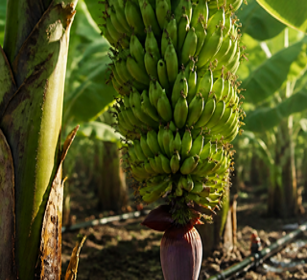
(iii) Fruit development stage : The banana heart’s stems elongate, and this is where the banana bunches grow. The better the banana plant is irrigated, the higher the bunch weight will be. One banana plant can grow 5 - 15 banana hands from one banana heart. The irrigation matter has to be handled very carefully here, as this final stage requires the most water, and proper irrigation yields better banana hands and higher bunch weight.
(iii) Fruit development stage : The banana heart’s stems elongate, and this is where the banana bunches grow. The better the banana plant is irrigated, the higher the bunch weight will be. One banana plant can grow 5 - 15 banana hands from one banana heart. The irrigation matter has to be handled very carefully here, as this final stage requires the most water, and proper irrigation yields better banana hands and higher bunch weight.
2. Effects of over-irrigation vs under-irrigation : Even if bananas are high irrigation fruits, over-irrigation is not going to help them. Rather, the roots could suffocate from overwatering, develop root rot, and even cause nutrient leaching, particularly of nitrogen and potassium. Under irrigation, on the other hand, could cause the plant to grow smaller fruits, poor bunch and hand formation and overall low bunch weight.
3. Soil type considerations : Banana plants grow the best in sandy loam, loamy, or clay loam type soil. Loam is not hard-packed, which helps the fibrous root stems grow, and it drains quickly, which is what a banana plant wants, as an abundance of water can cause diseases. Deep loamy soils that already contain a certain amount of organic matter are the best kind of soil for banana cultivation.
Benefits of Drip Irrigation in Banana Farming
- Water savings : Using a drip irrigation system for banana farming can save upto 50% water in comparison to traditional irrigation methods. Since water is delivered only to the root zone via the subsurface drip line and drippers, only the plants benefit, not anything else. And since only meeting the plants' irrigation needs is the foremost priority, water is saved in litres.
- Uniform water distribution : Since the water is delivered by the emitters in droplets at the same time and with no issue with unevenness of the soil, as the pipes used are pressure-compensating, such as the Netafim Dripnet PC AS dripline , the water is distributed pretty much very evenly and at regular intervals. No single banana plant is left out through this irrigation system.
- Improved nutrient uptake : By mixing in the fertilisers into the water that is delivered to the root zones, you can fertilise the banana plants at the same time via fertigation. All the nutrients the banana plants require can be supplied by the same drip irrigation system, which also improves plant growth by delivering fertilisers directly.
- Reduced weed growth and disease incidence : The amount of water that is delivered is just about equal to what the banana plant can absorb at a time. The water that is delivered is absorbed by only the plant, and there remains no excess water or nutrients for weeds to grow, nor for the root stem to rot from overwatering.
- Better root zone moisture control : By giving only the required amount of water to the banana plants, you can have a much better root zone moisture control. You can check for yourself using sensors or monitors to ensure the water is at the correct level. This will result in a healthy root system that will not succumb to rot or other diseases caused by overwatering.
How Precision Irrigation Increases Banana Bunch Weight
Consistent soil moisture during critical growth stages :
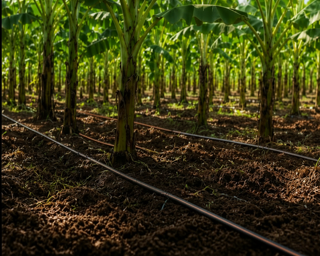
A consistent level of soil moisture that is established through highly controlled subsurface drip irrigation during critical growth stages will help the banana plant grow better. The banana heart will come out fuller, the number of banana hands will be higher, and the whole banana bunch weight will be much higher with regulated water droplets.
Prevention of water stress during fruit filling
Banana plants do not have a hard root system or a woody body; they are made of fibrous pseudostems. They require a lot of water to maintain these layers, as a banana plant is usually made up of 95% water, and the leaves are made of 85% water. If the plant faces water stress due to insufficient water, not only will the bunch not fill properly, but the pseudostem and leaves will also not be fully supported
Enhanced nutrient absorption through fertigation
Fertigation helps the banana roots take on nutrients successfully by delivering the nutrients in a steady drip at a rate that the plants are able to absorb more easily. The nutrients already present might not be enough, so fertigation can effectively take over this work. The fact that the drip irrigation system can also deliver fertilisers is a positive.
Drip Irrigation Design for Banana Crops
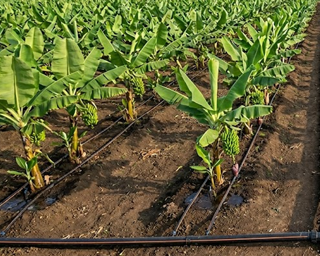
- Recommended spacing of drip lines and emitters : For banana cultivation, the recommended drip irrigation layout consists of two lateral lines per row of plants, with emitters positioned to provide adequate moisture throughout the active root zone. This ensures that the roots can efficiently absorb water and nutrients for healthy growth and better yield. A plant spacing of about 1 to 1.5 meters is generally considered suitable for banana cultivation. Accordingly, the placement of drip lines and emitters should be designed based on the field’s dimensions to ensure uniform water distribution and sufficient moisture availability for every plant.
- Number of emitters per plant : Given that a banana plant is huge in circumference than other similar row crops, it is of utmost importance that the correct number of emitters be placed around one plant. One banana plant will be fully supported, with 4 emitters placed around it to wet the root zone to the required depth. The emitters will irrigate the banana plant's root zone, ensuring the plant experiences no stress.
- Flow rate guidelines : Banana plants require daily irrigation and an increasing amount of water as they grow. A single banana plant will need 5 litres of water at the early stage and require more than 15 litres per plant during fruit filling. The exact flow rate depends on the soil's moisture content at any given time, and adjustments can be made to account for it.
Irrigation Scheduling for Maximum Bunch Weight
- Daily/weekly irrigation planning: Bananas require frequent and controlled irrigation, especially under drip systems. Average water requirement might come to 4.8–6.1 mm/day, with the total lifecycle requirement calculated at 900–1200 m
Typical drip irrigation schedule per plant is:
(a) 0–4 months (vegetative stage): 15 litres/plant/day
(b) 5 months to shooting: 20 litres/plant/day
(c) Fruit development stage: 25 litres/plant/day
This stage-wise increase is critical because the fruit-filling stage is the most water-sensitive and directly influences bunch weight. For drip irrigation, it is best to use daily or alternate-day irrigation to keep soil moisture uniform. The main concern here is that moisture depletion should not exceed 35% on any single day, or the plants will be left under stress.
Adjustments: Adjustments to the system might be required, depending on the weather, such as factors of temperature, humidity, rainfall, where the moisture levels may not require external irrigation. Soil moisture levels are the definitive values for these adjustments. With automation and soil moisture sensors, it is also easy to measure moisture levels at any given time and respond accordingly based on the data.
Fertigation Strategies to Boost Yield
With drip irrigation, any farmer can use the same system for fertigation. Using the drip irrigation system for fertigation means two things are addressed simultaneously: increasing fertiliser efficiency and improving water efficiency. The key nutrients that are highly important for better bunch weight are Nitrogen (N), Potassium (K), which is highly critical for fruit size, and Phosphorus (P), or an optimal combination in different ratios of NPK. As per the different growth stages, the fertiliser requirements are -
(i) Establishment (0-30 days): Use Nitrogen and potassium with urea to promote rapid initial root and shoot growth.
(ii) Vegetative Stage (30-150 days): High N-K use for a robust pseudo-stem.
(iii) Shooting Stage (150-240 days): Potassium needs peak here.
(iv) Development and Harvest (240-300 days): NPK in correct proportions for proper finger size and filling.
So long as this combination and schedule are followed, your banana plants will give you a hearty harvest and higher bunch weight. However, do remember to both irrigate and fertigate your plants consistently and meet all of their phenological needs. Using highly soluble fertilisers and a good-quality drip irrigation system, components of which can be found on Netafim's website, is the perfect way to ensure a high-yielding harvest.
- Overwatering leading to root rot : While bananas are high-water crops that require a lot of irrigation throughout the course of their growth, overwatering will not give you an even higher harvest, but rather make it possible for rot to take place within your banana plants' root stems. So be consistent and orderly, watering only as required.
- Uneven emitter distribution : If too few emitters or too many emitters are used for one single plant, then that will lead to either overwatering or underwatering and your whole harvest will face stress, and you will lose out on a good harvest. A single banana plant requires only 4 emitters to cover its root zone completely and maintain moisture levels. Any number, more or less, will negatively impact your harvest.
- Ignoring maintenance : Using a drip irrigation system also means that the system has to be maintained properly for it to function properly for a long time. Pipes can accumulate residue, and emitters can clog over time. Flushing and backwashing the system components will ensure that water is delivered properly. Even the filtration system has to be checked periodically to ensure the screens and other components are functioning properly.
- Incorrect fertigation timing : If the right proportions of fertilisers are not delivered to the plants, then they can not flourish in spite of using fertilisers. Fertigation makes fertilisation easy, but if the set schedule is not followed, it is of no use at all.
- Not adjusting irrigation during rainy seasons : During rainy seasons, when the plants are already getting enough water, adding more through the drip irrigation is only going to lead to rot and loss of crops. Any kind of irrigation has to be adjusted to either stop working or take a leave during the rainy season.
Conclusion
For banana cultivation, irrigation has to be consistent and controlled. The drip irrigation system must be maintained, and soil moisture levels must be monitored to ensure an ample supply for the healthy growth of the plants. Using a drip irrigation system will improve your yield by 20-50% and increase water efficiency to over 50%. Recap of key takeaways


COMMENTS
We'd love to hear your thoughts! To enter a comment, type your name and email address.