

Water Requirement of Sugarcane Under Drip vs Flood Irrigation
Introduction
Sugarcane is both a long-duration and a high-irrigation need crop. Sugarcane can take 10 to 18 months to reach full maturity, depending on the variety. It also needs a huge amount of water that has to be fed constantly. The water must be clean and potable, and the entire field must be irrigated regularly. Growing such a high-water-demand crop means you, the farmer, have to keep water readily available for irrigation to ensure a good harvest. Issues such as overall water levels have to be addressed at the earliest. One of the best ways to do so is to use a drip irrigation system rather than relying on traditional flooding methods. Let's find out how much water sugarcane actually needs and how much it can save by using a drip irrigation system.

Water Requirement of Sugarcane: The Basics
- Total crop duration : 10–14 months (on average)
- General water requirement : 1500 mm – 2500 mm per crop cycle.
- Equivalent volume : 6 to 10 million litres per acre
- Factors affecting the requirement : This requirement is influenced by the following factors, which may not be in the control of the farmer -
- Soil type : Sugarcane grows best in loamy soil, whether that be sandy loam or clay loam. The soil most compatible with sugarcane needs to be a bit loose, so the root system can grow without obstruction. It also needs to retain moisture to a level that allows the plants to absorb the required amount.
- Climate : Sugarcane is grown in subtropical and tropical areas in the country, as that is the best kind of climate for its cultivation. The amount of rainfall these parts get and how hot or cold these states can get are considerations the farmer has to make.
- Variety of sugarcane : There are different varieties of sugarcane, some with shorter harvest time and short in stature, while others are longer and have a longer harvest time. Shorter-harvest-time varieties can usually be cultivated within a year and have lower sugar and other by product yields, but the harvest remains consistent and regular.
Flood Irrigation: Water Requirement & Usage Pattern

- Typical Water Use : Flood irrigation usually uses 2000 – 2500 mm per crop or 8–10 million litres per acre. This large volume of water will yield 5-6 tonnes of sugar at a sugar recovery of about 9%.
- How water is applied : In flood irrigation, fields are flooded at intervals of one to two weeks or 7-15 days. This results in high evaporation and runoff losses, as the water disperses too quickly for the plants to absorb, and the unused water cannot be collected and reused.
- Efficiency : Flood irrigation has one of the lowest water efficiency values of all irrigation systems. Only 35–50% water is actually used by the crop, and the rest is wasted. Once flooded, the water cannot be extracted or reused.
- Key issues :
(i) Water wastage : Too much water is wasted. Since water is available to the plants, they have less time to absorb it and other nutrients, as excess water either evaporates or runs off. The amount of water actually required and the amount of water used are two different numbers.
(ii) Waterlogging : If there are any dips in the land, then water can collect in them from the flooding, which can lead to the roots of the sugarcane rotting due to being submerged in water for too long. Not to mention that it is very difficult to deal with.
(iii) Nutrient leaching : Flooding moves the top soil of the land with the force of its motions, sweeping the top of the field and leaching the naturally occurring nutrients that are in the soil. This nutrient can be difficult to recover with just flood irrigation.
(iv) Weed growth : Since ample water is given to the whole field, even in areas with no sugarcane, weeds tend to grow due to the excess water, which then leaches off nutrients from the soil away from sugarcane. Then managing the weeds falls on the farmer as well.
Drip Irrigation: Water Requirement & Usage Pattern
- Typical Water Use : Drip irrigation usually requires 1200 – 1600 mm per crop or 4–6 million litres per acre. Even this amount of water can yield 20-30% more, if used judiciously and focused on plant growth. The sugar recovery also grows to around 19%.
- How water is applied : In drip irrigation, the water is delivered directly to the root zone via emitters. The plants are irrigated daily, on alternate days, or twice a week, depending on the sugarcane growth phase. They require the most water during their grand growth phase.
- Efficiency : Drip irrigation, as an irrigation method, has one of the highest water efficiency among other irrigation methods. Drip irrigation has 85–95% water-use efficiency, as water is used as efficiently as possible.
- Key advantages :
(i) Minimal evaporation loss : Drip irrigation for sugarcane primarily uses subsurface subline pipes, which are placed a few inches into the soil so as to reach the root zones properly. Since water is delivered to the root zones within the soil, there is less opportunity for evaporation.
(ii) No runoff : Since the water is delivered so precisely in accordance with the plant’s needs, there is no runoff. With drip irrigation, there is no excess water to run off; nothing to roll over that the plants don't absorb. No runoff means no water wasted either.
(iii) Nutrient leaching : Flooding moves the top soil of the land with the force of its motions, sweeping the top of the field and leaching the naturally occurring nutrients that are in the soil. This nutrient can be difficult to recover with just flood irrigation.
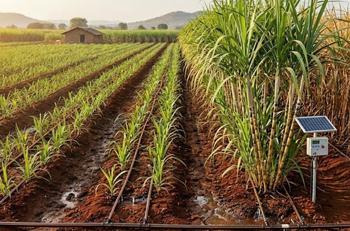
(iv) Better soil moisture control : It is far easier to control the moisture level with a drip irrigation rather than flooding since the moisture can be checked via sensors and monitors, rather than just letting it be from the flooding, assuming that everything has been covered.
Drip vs Flood Irrigation: Water Comparison Table
| Parameter | Flood Irrigation | Drip Irrigation |
|---|---|---|
| Total Water Used | 2000–2500 mm | 1200–1600 mm |
| Water Per Acre | 8–10 million litres | 4–6 million litres |
| Water Saved | Zero | 30–50% less water |
| Water Efficiency | 35–50% | 85–95% |
| Irrigation Frequency | Weekly | Daily/Weekly |
Impact of Water Saving on Yield
- Drip irrigation impact : With drip irrigation, sugarcane can yield more than 25-30% per harvest. With a higher water efficiency, where the water is delivered directly to the root zones only and at a speed that is optimal for absorption by the plants, not only will you be saving on water, but also ensuring a higher yield with precision and proficient irrigation.
- Why Higher Yield : This higher yield is driven by a multitude of factors, the most prominent of them being -
(i) Consistent moisture : Since a drip irrigation system can be controlled far more easily and with immense control, the sugarcane can be irrigated at the speed, amount and regularity that is required at every phase of their growth, and not one drop more. The required amount of water is all the plants get, so they are consistently moistened with no stress. This level of moisture helps the plants grow healthily.
(ii) Better nutrient absorption : A drip irrigation system can also be used for fertigation, which is a method of fertilisation by mixing the fertilisers into the irrigation water. The plants can absorb sufficient nutrients to meet their growth-phase needs. Sugarcane need a combination of nitrogen, phosphorus and potassium. With a drip irrigation system, the right combination of components can be distributed as required.
(iii) Reduced stress on the crop : Since the plants are able to get as much water as needed without overwatering them, the sugarcane faces no stress due to lack of water or proper irrigation. A stress-free environment will help plants grow healthily and reach full maturity more easily. Reduced stress also means the entire harvest will yield higher, with no plant loss.
Economic Impact: Water = Money
(i) Lower electricity/diesel cost for pumping : Since less water will be required in a subsurface drip irrigation system, there will be less need for constant or regular pumping to cover the water requirements. That means that there will be less spent on electricity and diesel costs to run the pump.
(ii) Reduced labour cost : With drip irrigation, manual irrigation workers will no longer be required, and you will be able to save on their wages. Reduced labour will also be a result of the fact that both irrigation and fertigation will be taken care of by the drip irrigation system, and you will not need as many workers to run your sugarcane cultivation properly.
(iii) Better fertiliser efficiency : Just like the water, the fertilisers, too, will be delivered to the root zones directly. That means the amount of fertiliser required will be reduced, as only the required amount will be used. This lowering of fertiliser will save you money as well.
(iv) Combined effect : The combined effect of all these factors is that the harvest will bring higher net profit per acre. The above-mentioned factors will compound the savings that a higher-yield harvest will bring you, and you will make serious savings in your field, as much as 25-30%.
Factors That Influence Water Requirement in Drip Systems
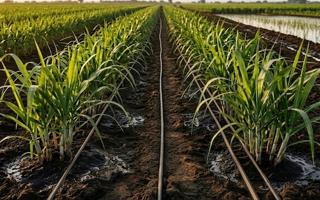
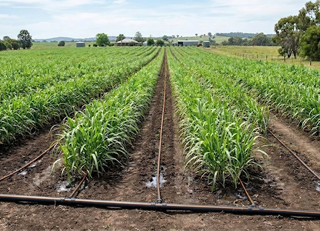
A. Crop spacing :
- The crop spacing will determine whether a paired row or single row drip line will be more appropriate. A paired row will irrigate two rows of sugarcane, while a single row will irrigate one single row. A paired row is recommended for sugarcane to lower initial setup costs, but a single row yields even better yields.
B. Soil water-holding capacity :
- Since loamy soil is the preferred soil for sugarcane, a drip system that is used for sugarcane can be used sparingly. Loamy soil tends to hold onto water for a bit longer than sandy soil and is not completely packed, which encourages root growth and water absorption. So the soil’s water-holding capacity directly supports plant growth.
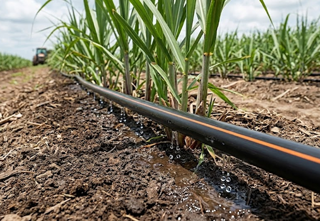
C. Dripper spacing and discharge rate :
- Drippers are spaced along the row of sugarcane so that they can deliver droplets of water at a set speed. The discharge rate can be controlled and set to different speeds to meet the irrigation needs of sugarcane at its specific growth phase. Drippers release water in controlled droplets. Water requirements are met seamlessly.
D. Irrigation scheduling practices:
- Sugarcane has three growth phases, and each phase has a distinct irrigation requirement. The first phase requires less water, followed by the grand growth phase, when the plants take in the most water, and then a period of the least water required. These phases dictate how much water will be required during a harvest for any field.
Common Mistakes Farmers Make
- Over-irrigation, even with drip : If the drip irrigation system is not reset at every growth phase of sugarcane, then the plants could face over-irrigation even with a drip irrigation system in place. Overwatering sugarcane can cause root rot, and you will lose a good harvest if you don't manage water properly.
- Poor system maintenance : If you use a drip irrigation system, then you have to keep maintaining it for it to function at its best. With use, the pipes can become clogged or accumulate deposits, leading to friction loss and hampering water distribution. Even with filters, some dust or algae particles might still pass through and clog the emitters. Doing proper, regular maintenance will help you drastically reduce the chances of clogging.
- Incorrect scheduling : If the drip irrigation system is set to improper irrigation schedules, then there is hardly any point in using such a system. Sugarcane needs to be irrigated early in the morning or later afternoon. Nighttime or midday irrigation does not help the plants at all. If irrigation is scheduled as it should be, you will enjoy a healthy harvest.
- Not using fertigation effectively : Using fertiliser via fertigation properly falls on you as the farmer. If you give all three elements of NPK in the same ratios and give them throughout the whole growth period, your sugarcane will not reach maturity in a healthy manner and will have very minimal sucrose content and limited sugar recovery.


COMMENTS
We'd love to hear your thoughts! To enter a comment, type your name and email address.