

The Link Between Yield and Sugar Recovery
What is Sugar Recovery?
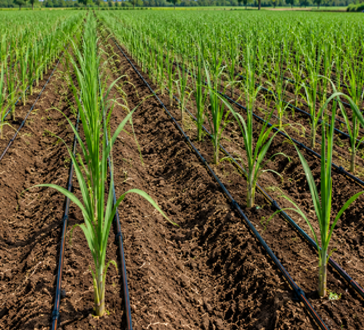
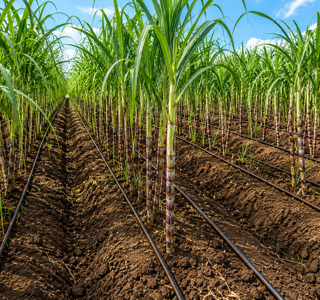
Sugar recovery is the amount of sugar that can be extracted from a ton of sugarcane. The sugarcane is first pressed, and all the juice is collected. Then comes the process of clarification, evaporation, and crystallisation into raw sugar crystals. Sugar recovery % is thus the amount of commercial cane sugar collected form a ton of sugarcane.
Why recovery matters?
Sugar recovery matters because it can give a near-accurate estimate of how much a whole field will yield and how profitable a single harvest can be, as much as tonnage for farmer profitability. The number of sugarcane stalks that a harvest gets can be a good indicator of how much profit you will get, but not every time. So recovery is a more accurate indicator of how much you will make, regardless of your actual harvest quality.
Challenges in traditional irrigation?
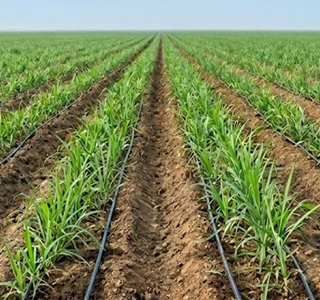
There are many challenges with traditional irrigation that render it suboptimal, particularly for sugarcane cultivation. Traditional irrigation, such as flooding, despite its high water volume, can lead to water stress, nutrient loss, and uneven growth. This leads to inevitable loss of money, effort and time.
Drip irrigation as a precision solution?
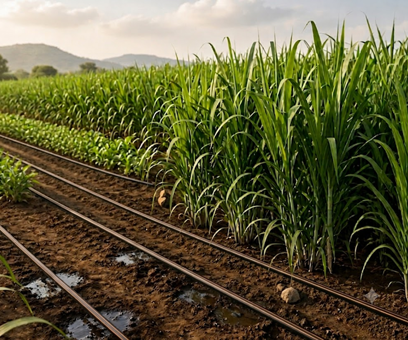
Drip irrigation solves many of the problems that traditional irrigation methods fail to address. Drip irrigation delivers water only to the root zones of plants, improving water efficiency; it can be run based solely on data from moisture sensors and saves a lot of money, labour, water, and fertiliser. In sugarcane cultivation, higher cane yield is good, but higher sugar recovery is even better, and using drip irrigation is one surefire way to get it.
What is Sugar Recovery Percentage in Sugarcane?
- Sugar recovery / CCS : Sugar recovery percentage in sugarcane is the percentage of crystal sugar that can be extracted from 1 ton of sugarcane. For a successful harvest, this number can hover between 13% and 19% of sugar recovery, with the other byproducts turned into usable products. Commercial cane sugar is the final product that undergoes a series of processes and is the main product of sugarcane.
- How mills calculate sugar recovery : Mills play a pivotal role in sugar recovery. The better they are able to extract sugarcane juice, the higher the sugar recovery percentage is. Mills extract sucrose from sugarcane and calculate how much is lost in the process as molasses, bagasse, and filter cake. This gives them an accurate number of how much sugar was present in the sugarcanes.
Factors influencing sugar recovery : There are many factors that can determine the rate of sugar recovery in a harvest. The most well-known of them are -
Variety : Different varieties of has different percentages of sugar yield as well as different period or reaching maturity. Some varieties may mature more quickly and yield less, while others may take longer to mature and yield similarly. It depends on the variety and how much sucrose they can produce.
Climate : If there is not enough water due to irrigation limitations, or if there is too much water due to incessant rain, or if there is too much sunlight at the wrong part of the growth phase, if you continue with your drip irrigation and fertigation even during heavy rainfalls, these things could impact the sucrose levels in the sugarcane.
Water management : Sugarcane cultivation has different irrigation needs at different phases of growth. At the seedling and tillering stages, water requirements are very low compared to those during the grand growth phase, needing as little as 1100 to 1500 mm of water per annum. Water access must also be monitored, since little is required after maturity.
Nutrient balance : Sugarcane cultivation requires fertilisers that are water-soluble. NPK, or nitrogen, phosphorus, and potassium, are the main components of a fertiliser for sugarcane. They have to be delivered to the root zones in exact ratios, which can change depending on the growth phase. Not all elements are required throughout the entire growth period.
Harvest timing : When the harvesting is done also helps in extracting the highest amount of sucrose from the sugarcane. Too early in their maturity phase, or too late, a harvest will not yield as much sucrose, as only fully mature stalks provide the best conditions for the highest extractions.
The Problem with Conventional Irrigation Methods
- Over-irrigation and waterlogging : Flooding, one of the most widespread conventional irrigation methods, can lead to over-irrigation and waterlogging. Sugarcanes need to be fed twice a week or after two weeks, depending on the growth phase. Giving too much water when not required can lead to rot and dead plants.
- Nutrient leaching and inefficiency : Conventional irrigation methods, such as flooding, will also lead to nutrients leaching as weeds will grow in the space between the stalks and take what should go to the sugarcane. Water and nutrient efficiency decrease significantly, possibly leading to plant stress.
- Irregular moisture supply: If the water is not delivered properly and expertly, then there is a high chance that not all the plants will be covered by the conventional irrigation methods. Irregular moisture supply will affect the harvest by leaving some plants unable to produce as much sucrose.
- Impact on : Using the imperfect conventional irrigation methods leaves an impact on -
Sucrose formation : Without proper irrigation at appropriate stages of the growth, sucrose formation can be negatively impacted, lowering the sugar recovery percentage.
Cane quality : If the water is not delivered well and in time, then cane quality can be impacted, leading to some stalks stagnating and never quite reaching maturity.
Fiber vs sugar balance : With improper water scheduling and using only conventional irrigation methods, the fiber vs sugar balance will be lost, with sucrose levels decreasing exponentially in comparison to fiber mass.
How Drip Irrigation Works in Sugarcane

- The water is delivered onto the root zone in a controlled method, which creates less opportunity for weeds to grow up and leach nutrients.
- Frequent, low-volume irrigation : The irrigation is frequent and low volume or high volume as required, set up via automating the system to help the farmer. You will be able to easily follow the growth phase and supply the correct amount of water.
- Integration with fertigation : A drip irrigation system is also very suitable for fertigation, where the fertiliser is mixed in and delivered to the root zones directly with the water, ensuring fertiliser efficiency.
- Uniform distribution across the field : The irrigation is frequent and low volume or high volume as required, set up via automating the system to help the farmer. You will be able to easily follow the growth phase and supply the correct amount of water.
Key Ways Drip Irrigation Improves Sugar Recovery
A. Maintains Optimal Soil Moisture:
- With a drip irrigation system, you will be able to prevent water stress during critical growth stages, take steps to avoid waterlogging so as not to harm the stalks, and support continuous physiological activity, answering all the needs in an appropriate amount.
B. Enhances Nutrient Uptake Through Fertigation:
- A drip irrigation system will also help in timely and precise nutrient delivery. Since balanced NPK delivery improves sucrose synthesis, fertigation via drip irrigation reduces nutrient losses.
C. Promotes Uniform Crop Growth:
- A drip system will result in even water distribution that will lead to uniform cane size and maturity. This uniformity will lead to better synchronisation at harvest, with the plants at the same stage of growth and maturity.
D. Reduces Excess Vegetative Growth:
- Controlled nitrogen supply prevents excessive leafy growth, which is possible with a drip irrigation system supported fertigation. Without these weeds, more energy is directed toward sugar accumulation
E. Improves Root Health and Activity
- Using a drip irrigation system for sugarcane cultivation can result in a better aeration and root-zone environment, since a stronger root system enhances nutrient absorption and helps the stalks absorb as much as they can.
Role of Growth Stages in Sugar Accumulation
- Early stage : At this point of sugarcane cultivation, the cut stems try to focus on establishment by growing roots and expanding the root zones. Sugar accumulation is not a point of importance at this stage, but having an established, deep root system will help the stalks reach the stage where they can accumulate a lot of sugar. Tillering also happens here, where each stem gets multiple shoots that will become the stalks.
- Grand growth stage : This point of the growth stage is all about biomass development. How high the stalks can grow, how wide in girth and how dense. The amount of biomass one stalk produces will be the holding place for the sucrose that will come next. The main growth phase sees each stalk grow as large as possible while getting all the required nutrients and water. This is the period when the plants need the most support and will suck up a high quantity of nutrients and water.
- Maturity stage : This is the final growth stage, and where sucrose accumulation occurs. The stalks have grown as much as possible, and with minimal irrigation and direct sunlight, they plump up with sucrose. Controlled irrigation during the maturity stage is critical for maximising sugar recovery.
Importance of Controlled Irrigation During Maturity
- Reducing excess irrigation near harvest : Having the option of controlled irrigation via a drip irrigation system that is fully automated and comes with real-time data about the moisture levels of the soil makes it far easier to lower the irrigation levels at the end of the harvest cycle, when the sucrose is accumulating in the stalks.
- Avoiding dilution of the sucrose content : Overwatering at the end of the harvest cycle comes with the risk of diluting the sucrose content, since hardly any water is required at that phase. Having a controlled drip irrigation system means you can dictate the speed and volume of irrigation at the appropriate stages and ensure there is no overwatering at the critical point near harvest.
- Maintaining ideal stress for sugar accumulation : After maturity is reached, sugarcane needs to be irrigated only every two weeks, with the soil’s moisture levels being consistent. This level of water stress leads to the accumulation of sucrose as the stalks try to compensate for the lack of water. Ensuring that plants receive just the right amount of water without being overwhelmed results in juicier crops.

Best Practices to Maximise Sugar Recovery with Drip System
- Stage-wise irrigation scheduling : If you have a quality drip irrigation system, such as one from Netafim, then you will be able to implement a stage-wise irrigation scheduling. Sugarcane cultivation requires different amounts of water at different growth phases, and managing this diversity in flow and frequency can be easily handled with a drip irrigation system.
- Balanced fertigation : Sugarcane is a crop that requires a combination of the three elements, NPK, or nitrogen, phosphorus and potassium as fertilisers. Not all are given at the same time, nor are they given in equal ratios. In the early phase, sugarcane requires the highest P application, followed by N. The grand growth phase requires both N and K. Following maturity, N is to be stopped.
- Avoid late nitrogen application : If nitrogen is applied for a long time after maturity, then it can suppress sucrose accumulation. It is therefore very important that Nitrogen be completely stopped after maturity.
- Monitor soil moisture and crop health : The soil moisture has to be monitored throughout the whole growth phase so that the sugarcane does not face any kind of water stress. Soil health should be given equal importance to ensure a healthy harvest. Check whether your soil is alkaline or acidic, and take steps to make it more alkaline.
- Timely harvesting at peak maturity : If you wait too long after maturity to harvest your sugarcane, then, in spite of having a huge harvest, your sugar recovery can be compromised as there can be substantial loss of sucrose due to evaporation. So, timely harvesting is necessary.
Common Mistakes to Avoid
- Over-irrigating during maturity : Once the sugarcane has reached maturity, they dont need as much water, and this has to be monitored very strictly. Overwatering after maturity can dilute the stalks' sugar content, leading to a poor overall harvest and low sugar recovery.
- Excess nitrogen application : Post-maturity, the plants do not require any more nitrogen. If nitrogen is applied after maturity, the stalks may suppress their sucrose accumulation, resulting in significant losses for the farmer.
- Poor system maintenance : When you use a drip system for irrigation and fertigation, you absolutely must maintain it properly. You have to check that there is no clogging, no leakage, and that everything is running smoothly.
- Ignoring crop stage-based scheduling : As sugarcane has three main growth phases with different irrigation and nutrient needs, it is the best possible method to employ crop stage-based scheduling for both water and nutrients. With proper scheduling, the plants will get what they need when they need it, without excess waste or overuse.
Conclusion
Water management directly impacts sugar recovery. Using a drip system means you will have better control, get higher-quality plants, and enjoy higher returns and yields. Using precision irrigation to maximise both yield and sugar recovery is a smart move for any sugarcane cultivator and can make the difference between a healthy, high-sugar recovery harvest and a disappointing one.


COMMENTS
We'd love to hear your thoughts! To enter a comment, type your name and email address.