

The Environmental Benefits of Drip Irrigation Systems
As a species, we are heading into a future of even greater water scarcity. The area of arable land is going to shrink even more as people need space for themselves. Agriculture, which is a hard enough occupation, is going to become harder for a multitude of reasons, but the lack of water is perhaps the most important. As water in rivers, lakes, and reservoirs recedes and groundwater levels continue to decline, it becomes the responsibility of farmers to use the water available to them judiciously.
A method of irrigation that addresses all these concerns and offers a valuable alternative is drip irrigation. Using a drip irrigation system to irrigate orchards, gardens, fields, and more saves water and prevents excess water waste. Drip irrigation is the catalyst for sustainable agriculture, and modern farming must adopt this irrigation method for the sake of its farms and fields, as well as its future. Conserving water and energy in agriculture now is the key to saving water for the future.
What is Drip Irrigation?
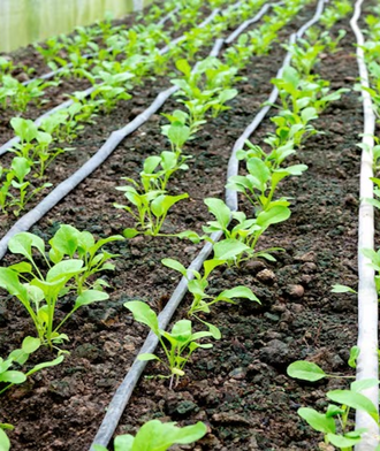
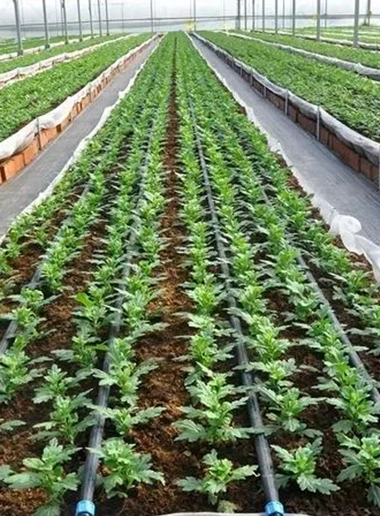
Drip irrigation is a system of irrigation in which water is delivered to the root zones of plants in droplets at regular intervals.The Right amount of water, at the Right place, at the Right time the water efficiency of this irrigation system is the best, as only as much water is used as plants require. Such a drip irrigation system will have emitters, pipes in designed layouts, valves to maintain and regulate water pressure and flow and filters to clean the water used.
Compared with traditional irrigation methods, such as flooding, where fields are watered to excess to cover all plants, drip irrigation saves 40% or more on water and still yields 35%-55% better per harvest. With such a system in place, farmers can cut costs on excess labour, water, and nutrients while still promoting better plant growth.

Precise water delivery directly to plant roots
In drip irrigation, the water is deposited directly to the root zones of the plants, where they have the best access to absorb the water and other nutrients, rather than just watering the whole area and letting them grab what and how much they can. Precision irrigation increases water efficiency manifold.
Importance in drought-prone regions
In areas where readily access to water is already low, agriculture becomes very difficult. With drip irrigation, farming can be done on half the water, and still get a good harvest.
Reduced evaporation and runoff
Since the water is given only to the root zones, there is a very low chance of evaporation from excess irrigation or even runoff. The water delivery is so precise that no water is wasted, reducing evaporation and runoff.
Statistics or examples of water savings
More than 40% of water can be saved using drip irrigation systems, while still promoting consistent, healthy and higher harvests.
Reduction in Soil Erosion and Degradation
Controlled water flow prevents soil displacement - Precision irrigation, such as drip irrigation, delivers water through a very carefully laid volley of pipes, emitters and drippers. So the water is delivered without moving the rest of the soil.
Maintains soil structure and fertility - In traditional methods such as flooding, water is released into large streams, significantly altering topography and soil levels. Drip irrigation, on the other hand, is better at maintaining soil structure and fertility intact.
Minimises nutrient leaching - Only the required amount of water and nutrients is used in drip irrigation, and no extra access is provided to spaces in between the plants. This leads to fewer weeds growing there and less leaching of water and nutrients from drip irrigation.
Lower Fertiliser and Chemical Usage
Fertigation - Fertigation is the method of delivering nutrients through irrigation, where fertilisers are mixed into the water for distribution so that water and nutrients can be delivered at the same time and in the same way. This works exceptionally well in drip irrigation. So with only the required amount of water, only the necessary amount of fertilizer is delivered.
Reduce overuse of fertilisers - Since only the minimal amount of fertilizer that satisfies the plants and no more is delivered by a drip irrigation system, this means that there is no overuse of fertilisers. Overusing fertilizers can make them ineffective in the long run and make plants susceptible to diseases. So only the appropriate amount is given, never more.
Less chemical runoff into nearby water bodies - The amount of fertilisers distributed by a drip irrigation system is equal to the plant's needs and absorption amount, and not one drop more. So there is no excess that can run off into nearby water bodies and pollute them.
Environmental impact of reduced pollution - A reduction in pollution of any kind is invariably good for our planet. At the same time, drip irrigation reduces water pollution and improves water efficiency, offering many environmental benefits that traditional irrigation methods lack
Energy Efficiency and Carbon Footprint Reduction
Require lower water pressure than traditional systems
If one uses PC drippers, or pressure-compensating drippers, as produced by Netafim, then it does not matter what the elevation or slope of the farm or orchard is. The water will be delivered properly, in the proper quantities, at perfect intervals. So, a lack of water pressure does not hamper plant irrigation, unlike in traditional methods.
Reduced energy consumption for pumping
Since lower pressure can be bypassed by the use of appropriate products, such as the PC drippers from Netafim, farmers can use less energy to pump for their fields and irrigation methods. By optimizing water distribution even under low-pressure conditions, these systems reduce operational costs and improve efficiency for farmers every day.
Indirect contribution to lower greenhouse gas emissions
Lower water wastage, better yield with less electricity power, less labour needs and less amount of fertilisers results in lower greenhouse gas emissions. The plants' needs are fully met with minimal irrigation, which significantly reduces environmental impact. The transportation costs for the labourers themselves are significantly reduced.
Improved Crop Health and Yield
Consistent moisture levels - The water is delivered to the plant’s root zones at a consistent speed, and ensures that the soil’s moisture levels within the root area never lack water. The plants never have to face stress due to a lack of water.
Reduced weed growth - Water is given only to the plants, and the space between them is free from any weeds. Drip irrigation reduces weed growth substantially.
Lower risk of plant diseases caused by excess moisture - The water given is in tandem with what the plants need and never more. So there is no chance of overwatering, which can lead to plant diseases.
Support for Sustainable Agriculture
Aligns with eco-friendly farming practices - Drip irrigation is one of the most sustainable irrigation methods for any kind of farming or harvesting. It aligns perfectly with other eco-friendly farming practices such as using solar power to run the farm or orchard.
Helps farmers adapt to climate change - Rather than hanging onto old traditional methods that no longer work or are not feasible, drip irrigation helps the farmer come to terms with climate change and how to use the resources that are left judiciously.
Suitable for various crops and terrains - Drip irrigation can be used for different crops with different irrigation needs, and can be installed for farms, orchards, and landscape gardens and more in slope or hilly areas with no problem.
Challenges and Considerations
Initial setup cost - A good and lasting drip irrigation system can cost around Rs. 60,000/- per acre. So a large farm will require enough products, all of which are available at Netafim, to cover its entire field. This could be daunting for some farmers and may make them hesitate to pursue it, even though they would benefit so much from it.
Maintenance requirements - The drip irrigation system has to be maintained properly to ensure that there is no clogging and no issues with filtration via regular maintenance checks. The farmer and their assistants must know how to do this and resolve any problems that arise.
Need for proper design and management - Only a proper system that has a perfect design and covers all of the particulars of this method should be selected. Netafim offers everything needed to set up an effective drip irrigation system, with each product compatible with the others. That makes the system easy to design and manage.
Conclusion
Using a drip irrigation system is the best thing a farmer can do for their farm, orchard or garden, as well as for the environment and the planet. A drip irrigation system is a water-, time-, and money-saving option that farmers need to install to continue farming for the long term despite water scarcity or climate change. Get yourself such a system and achieve a better yield while making the world better for everyone.


COMMENTS
We'd love to hear your thoughts! To enter a comment, type your name and email address.