

Cost and ROI of Banana Drip Irrigation Per Acre
Introduction
India is still considered an agricultural country. 50% of India’s workforce is employed in agriculture, with around 60% to 70% of the country's population being directly or indirectly dependent on agriculture. Traditionally, farmers in India have used old methods, such as flooding, to irrigate their fields and orchards, but these methods are no longer sustainable. We now understand the growing importance of water-efficient farming in India. India also grows many water-intensive crops, such as banana, which historically require enormous amounts of water throughout their cultivation cycles. But now there are other options, and if you are cultivating bananas, you will get many benefits from drip irrigation. Let's find out what it entails for the Indian farmer.

Why Drip Irrigation for Banana Farming?
Banana plants have a high water requirement for growth, and one single banana plant can use up 1000 mm per year to 2000 per year, depending on the breed and harvest cycle. Water requirements are consistent throughout the growth period, and significant water waste occurs when flooding irrigation is used. The high water demand of banana crops makes drip irrigation systems a far better option, as precision irrigation can achieve up to 90% water-use efficiency. That means all the water delivered by a drip irrigation system is absorbed and used by the banana plants, with virtually no loss.
The key benefits of using a drip irrigation system are:
(i) Reduced water wastage : There is a significant reduction of water wastage, reaching around 40–60% savings for one single harvest. As we face water scarcity worldwide, using measures such as drip irrigation not only saves the cost of additional water but is also an environmentally sound decision. Water is saved without compromising plant growth, and only the amount required is used. This also eases input costs for the farmer.
(ii) Improved yield consistency : With a drip irrigation system in use, a farmer can have the peace of mind that the improved yield will be consistent and will continue to be so. Drip irrigation systems cover each plant and fruit-bearing tree by design, so every banana plant will be covered and irrigated in a proper and timely manner. This inevitably leads to the fruit filling in better during that growth phase, resulting in higher banana bunch weight.
(iii) Better fertigation and nutrient control : It is easier to distribute fertiliser to the banana plants via fertigation, which uses the drip irrigation system to deliver the nutrients right to the root zones of the plant. Since the fertiliser mixture is introduced through systems such as a venturi or an automatic dosing system, such as the its updated to Netajet 5g or else write Fertikit 5G it becomes much easier to control the amount and speed of nutrient delivery. So the plants are well fertilised and more efficiently irrigated with a drip irrigation system.
Drip Irrigation Cost Per Acre for Banana in India
Average Cost Range :
A drip irrigation of good quality from a reputable and established company, such as Netafim, can cost around ₹25,000 - ₹60,000 per acre, depending on system quality and design and how many products will be used. For a more specific number for banana cultivation, a drip irrigation system can be bought for ₹25,000, enough for one acre.
Cost Breakdown :
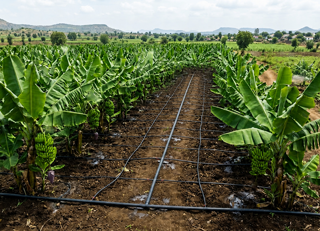
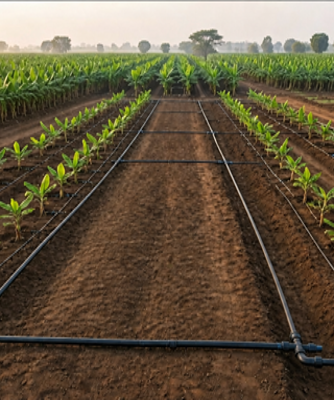
A drip irrigation system will have certain components that have to be bought separately and then assembled together to work. The components include a reliable water pump and a water source setup, including a main water source, appropriate filters, and fertigation units. Once the water has been extracted from the water source and filtered, a network of mainline, sub-main, and lateral pipes will be laid to deliver the water and nutrients. Emitters and connectors will be placed wherever required. The whole installation process will require a one-time labour charge, and will provide the final estimate of the system cost for your field.
Factors Affecting Cost :
While the main components of the drip system and its installation will account for most of the cost, there are certain things that could further define the installation cost. For banana plants in particular, plant spacing is very important to encourage proper growth. Then you have to factor in the soil type and terrain you're dealing with, and whether the soil needs any special treatment to improve it. Whether the water source is fully available, must be shared with other farmers, or recedes at certain times. And finally, the quality of the products, including brand and material quality. If you are going to have a drip irrigation system installed, it makes no sense to go with any company’s product other than the best available.
Government Subsidies and Financial Support
Across India, covering more than half of the states, the Indian government offers a special subsidy for the purchase of a drip irrigation system. The PMKSY (Pradhan Mantri Krishi Sinchai Yojana) allows farmers to buy and install a drip irrigation system of their choice, provided they submit all required documents and particulars. The subsidy covered 35–55% of the initial cost, depending on the state and farmer category. The subsidy even covers up to 90% in a few select states. Once the drip irrigation system components are bought and then installed, the final instalment of the subsidy will be released, making the effective cost of the system after subsidy approximately ₹18,000–₹44,000 per acre.
Operating Cost Savings with Drip Irrigation
When you buy and install a drip irrigation system, you will experience reduced electricity and water pumping costs, for only a limited amount of water and fertilisers will be required, thus lessening the use of electricity and water pumps. There will also be significantly lower labour requirements, as the system will handle both irrigation and fertigation in the field, eliminating the need for manual handling. There will also be a significant decrease in weed growth and disease incidence, as water will be delivered to the root zone, preventing weeds from leaching nutrients and water. Using a drip irrigation system will even enhance efficient fertiliser use, providing the banana plants with the required nutrients and nothing more.
Yield Improvement in Banana Farming
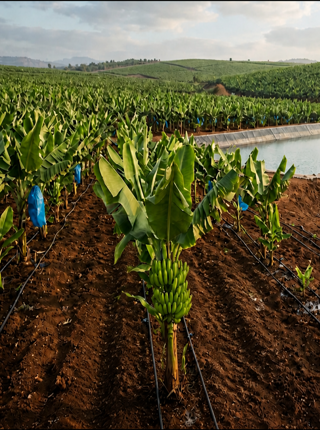
When you use a drip irrigation system for your banana farm, you will find that, with the better moisture control it provides, you always end up with healthier plants that experience no stress or rot. Using the drip system properly will increase your yield year over year. You will find that plants that used to give only 15 kilos of bananas before have risen to 25 kilos or even more with the use of drip irrigation. The yield increase potential increases 15–40%, depending on management and banana breed. Using cultivars such as the drought-resistant G9 or the Grand Naine banana variety can increase a single banana plant's yield to more than 40 kilos. With consistent irrigation and fertigation at the appropriate times and durations, you will even find that the fruit sizes are bigger and that all the bananas in a hand look uniform, which is what the market wants.
ROI Calculation Per Acre
- Investment : If you are a farmer who is growing bananas on an area of one acre, and are in a position to apply for the subsidy, then you will be able to purchase a good drip irrigation system assembled from high-quality products from a good company like Netafim. The cost of the initial purchase will likely range between ₹20,000 and ₹40,000 after subsidy. This is the only amount you will need to pay on your end, as the rest will be covered by the subsidy.
- Annual Benefits : If the annual benefits of a drip irrigation system for one acre are calculated, it is very easy to come up with an approximate estimate of how much money you will be saving in a year. First and foremost, you might be able to save ₹5,000–₹9,000/year from lowered water usage, up to ₹60,000/year from labour cuts, as you will need only a skeleton crew to keep the irrigation running without full manual participation. And with consistent and even irrigation, your yield can increase from ₹30,000–₹80,000/year, covering the cost of your drip irrigation purchase within one harvest.
- Payback Period : Banana plants take 9 months to one year to grow and reach full maturity. You will be able to cover your payback within one or two harvests at the maximum. A one-time purchase and installation of a well-maintained drip irrigation system will last 7–10 years or more. So the one-time purchase and installation costs will be covered by your first two harvests, and then you can continue using the same system for almost a decade, enabling you to collect your profits in a lump sum for years.
Real-World Considerations
If you have already decided that you are going to purchase a drip irrigation system, then you must be aware of the following considerations that you have to attend to for proper running of the system -
- Maintenance requirements : You need to regularly check that your pipes and emitters are free of any clogging, and do repairs wherever required. You need to check that the sensors and monitors that you are using are fully charged and transferring accurate data. You also need to check whether your filters are working properly and whether any filter screens need to be replaced. Whether your automatic fertiliser dosage units are dispersing the fertilisers well. Since a portable drip irrigation system can easily cover an acre of field, you also need to regularly check the Netafim FlexNet flexible pipes and other components to ensure it runs well and last long.
- Importance of proper installation and training : To install the drip irrigation system, it is best that the professional installation team that is experienced and able to provide on-the-spot advice does the installation. They will be able to check the area and decide whether pressure-compensating pipes or emitters are required, which filters are best suited for your main water source, and whether any particular adjustment is needed based on the soil type or land slope. They will also be able to provide basic training to teach your workers how to work the system and maintain it well. Even if they do not get the specifics, having someone show them how to check the pipes and flush them will benefit you and your banana field. Netafim has such teams ready to help you at any time.
- Risks of low-quality materials : There is nothing stopping you from rustling up a drip irrigation system with odds and ends of whatever you can find, with no thought given to the grade and material of the parts used. After all, it is just irrigation, delivering water to the banana plants. But if you don't think that there is a huge difference between what you can make and an actually thoughtfully put together system of good products made of high-quality materials, then you are very wrong. Using subpar products made of sketchy, low-quality materials will just harm your banana plants more than anything, as they will leach chemicals into the water and be unable to even water the plants uniformly.
Comparison : Drip vs Traditional Irrigation
| Parameter | Flooding | Drip Irrigation |
|
Water Usage Efficiency |
30-50% | 85-95% |
|
Cost Over Time |
High | Low |
|
Yield And Profitability |
Moderate | 20-50% |
|
Sustainability Impact |
Poor | Strong |
Common Mistakes Farmers Make
- Choosing the cheapest system instead of a durable one : If finances are dire, then a farmer may choose to go with the cheapest system available instead of a durable one. They might think that both work the same, but a good drip irrigation system will last nearly a decade, whereas a cheap one might need to be replaced within a year. By choosing a cheap system that has to be replaced every year, the farmer will lose much more money than by buying a durable system, since maintenance costs are definitely lower than buying a new one every year..
- Ignoring the filtration system : The filtration system that is used in the drip system has to be compatible with the main water source. What are the contaminants and matter that are being filtered will decide what kind of filters to use, whether media filters are required or screen filters will do. If the filtration system is not well-managed and well-maintained, the pipes and drippers, as well as the lateral pipes and emitters, will all suffer, clogging easily and quickly because the filtration system is not working efficiently. Residue can build up in the pipes, and emitters that are fully clogged will no longer irrigate your banana plants.
- Poor irrigation scheduling : Bananas are high-water-intensive plants and require quite a considerable amount of water throughout the growth periods. They can also absorb water during the early morning hours; 5 am to 8 am is their prime irrigation time. If the drip irrigation system is set up incorrectly, the banana plants will be irrigated at the wrong time of day, making it difficult for them to absorb water. And if water is scheduled inconsistently, even with a very good drip irrigation system, the harvest will not reflect the high potential of drip irrigation.
- Not utilising fertigation : Since the drip irrigation system is already there, there is no need to use the same system to fertigate the plants properly as well. With the subsurface laterals and drippers, not only water but also the perfect mix of fertilisers can be delivered to the root zones of the banana plants, thereby ensuring that the plants receive ample nutrients to absorb along with the water. When the option is there and implementing it is so easy, deciding not to do the fertigation will only harm the plants. Fertigation will also reduce the amount of fertiliser and labour needed, and is very beneficial to the farmer and the plants.
Long-Term Economic and Environmental Impact
- Improved farm profitability : Using a drip irrigation system properly, whether a portable one or a stationary one, is guaranteed to increase your banana farm profits. The banana bunch weight will improve a lot, wherein one banana plant that used to give only 15-20 kilos of bunch weight each harvest might be able to produce as much as 35-40kilos instead. Using draught-resistant varieties like the Grand Naine or G9 will give even more.
- Water conservation at scale : Over the years of cultivation, a drip irrigation system will save a lot of water, which will even impact the water conservation numbers for the area. Even for a high-water-intensity crop like bananas, properly using drip irrigation will enable the farmer to save more than 30% of water during each harvest cycle. This number will remain consistent over the years the drip irrigation system is used, and it can only benefit the environment and the plants.
- Climate resilience for Indian agriculture : We are coming to face an increasing water scarcity and water insecurity over the years. Using a drip irrigation system helps address the crisis while still allowing farmers to continue farming and achieve good yields.
Conclusion :
Getting a drip irrigation system is an investment, not an expense. It is one of the stable, sustainable options available to banana farmers who rely on limited resources, without reducing yields on farms and plantations. Get the drip irrigation system, if not for yourself, then at least for your plants and the planet.


COMMENTS
We'd love to hear your thoughts! To enter a comment, type your name and email address.