

Complete Guide to Drip Irrigation for Sugarcane in India
Introduction
Sugarcane cultivation is very important in India. It is the second most grown crop in the country, and engages around 50 million farmers and families in its cultivation. The most valuable byproducts from sugarcane are sugar, molasses, ethanol and power generation. Sugarcane remains one of the most stable cash crops in India and is a favourite crop in the subtropical states of UP, Uttarakhand, and Bihar, as well as in the tropical states of Maharashtra, Karnataka, Tamil Nadu, and Andhra Pradesh.
Sugarcane are considered a Water Intensive crop because they have a high water demand and can take up to 18 months to reach full maturity. They also need to be fed consistently throughout their growth cycle. They require about 250 tonnes of water to produce one ton of sugarcane. The long growth period and high water use make sugarcane an inefficient growing using flood irrigation or traditional irrigation. . Excessive waterlogging may damage roots and reduce crop yield in flood irrigation methods.
An alternative that will fulfil the irrigation requirements of a sugarcane field and reduce water usage is something a sugarcane farmer seriously looks for. This option, without a doubt, are precision irrigation method. Drip irrigation is a far better irrigation system for sugarcane farming than traditional irrigation methods. In the following essay, all the details about how you can upgrade your currently existing irrigation system or setting the new system of drip irrigation for the benefit of your sugarcane farm are provided. Why you should adopt this new system will become very clear.

What is Drip Irrigation?
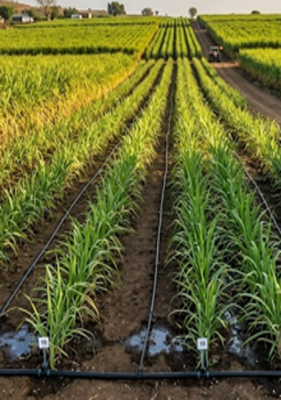
Drip irrigation is an irrigation system in which water is delivered directly to the root zones of plants. The pipes that deliver this water may be surface pipes or sub-surface, depending on their placement. This irrigation system is best suited to deliver a consistent water supply to sugarcane plants. The delivery system also saves water by using only the required amount, not more. A drip irrigation system requires a water source, pipes of various lengths and diameters, filters, valves, emitters, and drippers. You can choose between a surface drip irrigation system and a subsurface drip irrigation system.
Why Drip Irrigation is Ideal for Sugarcane
- The deep-rooted nature of sugarcane makes it highly suitable for drip irrigation systems with subsurface pipelines, as water can be delivered directly to the root zone efficiently. Since sugarcane roots extend much deeper than those of most seasonal crops, the crop requires regular and consistent irrigation to maintain adequate moisture levels for healthy growth and optimum yield.
- Continuous moisture requirement - Sugarcane requires a continuous and well-balanced moisture supply because of its extensive root system and tall growth. Water must be delivered consistently across the wider root zone without causing overwatering. Maintaining optimal soil moisture at all times is essential for healthy plant growth, and this can be effectively achieved through drip irrigation. Proper irrigation management also ensures that the plants do not experience water stress at any stage of growth.
- Suitability for Indian agro-climatic conditions - Given that sugarcanes can be grown in abundance in sub-tropical and tropical areas, these plants are highly suitable for the Indian states that exhibit compatible agro-climatic conditions. The sugarcane plants receive optimal amounts of nutrients, sunlight, and water through a drip irrigation system.
A. Water Savings:
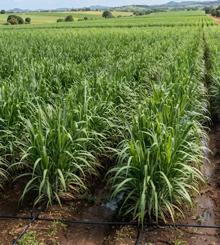
Using a drip irrigation system for your sugarcane fields saves up to 50% water compared to flood irrigation or other traditional irrigation methods, such as manually irrigating each plant. Since sugarcane is a long-duration crop that requires consistent water throughout its growth, which can last from 10 to 18 months, a drip irrigation system makes the most sense. The water is delivered judiciously without overwhelming or underwatering the plants, and only in the area where it is most required, the root zones. So water is saved without the plants facing a loss, and that is for the best.
B. Higher Yield :
With the proper installation and use of a drip irrigation system for a sugarcane field, there can be a 20-30% increase in yield per harvest. Since water delivery is consistent, the sugarcane plants do not experience water stress. They also become sweeter, with a higher juice yield per stalk, because water is always available for growth.
C. Better Fertiliser Efficiency :
A drip irrigation system not only delivers water to the plants in an ample amount, but it also can deliver fertilisers and nutrients to the plants in the same way. Fertigation is the method of mixing fertilisers into the water and then irrigating the plants at the root zones. This enables plants to absorb nutrients as easily as they absorb water. Using this method, you can use optimal fertilizers and can manage by purchasing 20-30% less than before.
D. Improved Crop Health :
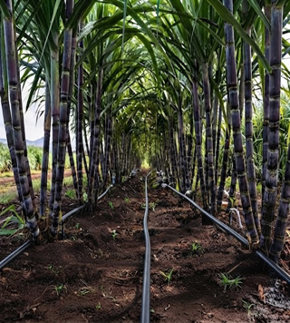
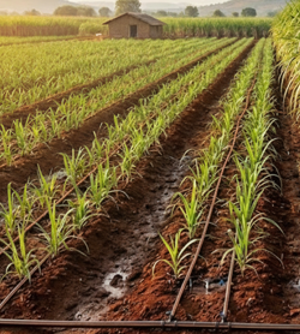
Using a drip irrigation system ensures that there is less space and less excess nutrients for weeds. The lack of weeds reduces the number of pests that could reach the other plants. With consistent water delivery, the plants are free of diseases that can arise from insufficient or excessive watering. The sugarcane plants grow uninterrupted, without missing out on water and nutrients, and become fully mature plants with a high yield margin.
E. Labour & Cost Efficiency :
Fully automating the drip irrigation system has the added benefit of reducing labour dependency in addition to providing you with real-time data and measurements about the irrigation. Moisture levels and nutrient needs can be monitored with sensors, which will be far more accurate for your sugarcane plants. You won't have to depend on a whole slew of workers to manage the sugarcane plantation if the work is already taken care of. The irrigation will be efficient and lower labour costs.
Components of a Drip Irrigation System
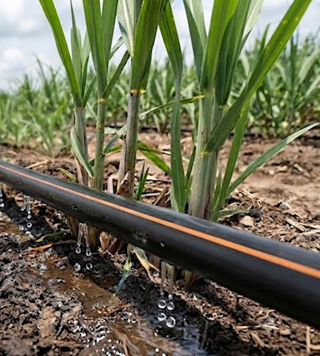
A drip irrigation system has a few main components with elements that can be added on to make the irrigation more accurate and easier. The first and foremost is a water source, preferably on your land or within easy access. It may be a borehole, a canal, or even a tank. A pump unit needs to be fitted to extract the water from these water sources. The pump must run for the required time. The filtration system depends on the kind of pollutants and impurities that may be present in the water. Screen filters remove fine impurities such as silt and other small particles, while media filters help trap larger impurities such as algae, small stones and other debris.
To deliver water, there needs to be a water mainline and submain pipes. The mainline will connect to the filter and deliver filtered or fertigated water to the sub-main pipes. These pipes are purely to carry the water to the drip lines. The drip lines or lateral pipes will be either on the surface or below it, near the crop line.The emitters or drippers are placed near the sugarcane plants, and the drippers are pre-fitted in the laterals with available spacings of 30 cm, 40 cm, 50 cm, and 60 cm. The emitters will be set up on a schedule to deliver consistent water to the sugarcane plants without overwatering. Sensors might be placed along the way to measure how well the system
Layout Design for Sugarcane Fields
- Row spacing and emitter placement : Unlike other row crops, sugarcane plants require a certain amount of space between the initial stem cuttings as they grow. Sugarcanes not only have a deeper root zone but also increase in circumference and height over time.
- Single vs double lateral system : A drip irrigation system for such a sugarcane field will require a specific layout that usually includes a single lateral pipe for two rows, with emitters appropriately placed along the way. Single lateral systems usually suffice for sugarcane plantations.
- Surface vs subsurface layout : Since sugarcanes have deep roots, its is best to utilise subsurface lateral pipes and put in the emitters or dripper at a depth where the whole root zone is able to take nutrients and water with ease. Subsurface layout will also lead to less wear and tear due to weather conditions.
- Field slope and soil considerations : If the field is sloped or the land is uneven, then Netafim Pressure Compensating pipes are required to regulate the water pressure and ensure that all the plants are irrigated properly. The type of soil can determine the depth of the laterals and spacing of the dripper as well. Loam and clay soils, which are abundant in the subtropical and tropical regions of India, are the best types of soil for sugarcane, and drip irrigation systems can be installed here very easily.
Installation Process
- Water Source : Securing a water source is the first step in installing a drip irrigation system. The water source must be clean and provide enough water to cover the entire field. Filters and fertigation needs will also be included in this portion of the installation. Filters will depend on the source water, and fertigation will be used via the water after filtration.
- System design planning : As per the slope of the land, the area of the field and how many individual plants may need to be covered, as well as the distance from the water source to the furthest sugarcane stalk, these information will help design the perfect irrigation system. The layout will have to contend with varying pressures, manage unevenness, and reach even the faraway plants.
- Pipe laying : Once the design has been decided, to best irrigate every
sugarcane stalk, then the pipes will be laid. The Netafim FlexNet flexible pipes are the best pipes for main or submain water pipelines, whereas the Netafim PE pipes are best for lateral placement. Before the pipes are installed, the drippers or emitters will be set at the proper spacing and intervals. - Testing and pressure regulation : Once everything is in place, the system will be tested and regulated for any kind of pressure variation. Should any issues arise, a proficient, professional installation team will resolve them quickly. It is best to have a professional installation team install the drip irrigation system so that any issues that come up can be rectified on the spot.
Irrigation Scheduling for Sugarcane
A. Crop stages:
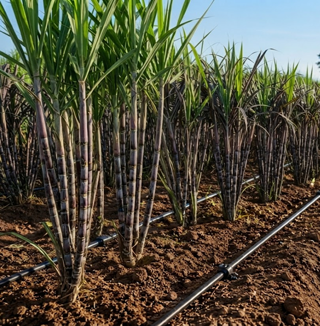
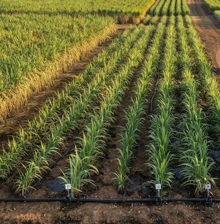
Different growth stages of sugarcane plants will require different intensities of irrigation. After planting the sugarcane stems, the first step is to encourage root growth. In these early days, they need consistent but light irrigation. Once a strong root system has been established, the grand growth period follows, when irrigation needs are at their highest in a sugarcane field. Here, the plants need to be irrigated at a consistently high level. Once maturity is reached, then the irrigation can taper off a bit, with water given every 2 to 3 days.
B. Frequency and duration of irrigation :
At first, watering has to be light and is best delivered in the early morning or evenings per day. During the grand growth phase, water is to be given consistently without overwatering. After maturity, the frequency can be reduced again to watering every 2 or 3 days. But the final amount will depend on the plants' evapotranspiration rates.
C. Soil moisture monitoring :
Sugarcane farming needs sensors and monitors to measure the moisture levels of the field, as too little water will impact their growth and too much will lead to rot or worse. It is best to have the exact water requirement data and adjust the water as needed. This monitoring will also save on water and help save money during the rainy seasons when extra irrigation is not required.
Maintenance Tips
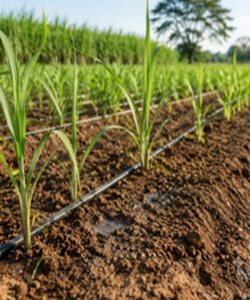
If you want to use your drip irrigation system for sugarcane cultivation, you will need to maintain it properly so it lasts long and without problems. Regular cleaning of filters is an absolute must, as is flushing the pipelines through backwashing the water. This helps dislodge any impurities stuck in the pipes and restore their frictionless performance. The emitters and drippers need to be cleaned periodically to prevent clogging and ensure they work properly. There is even a seasonal maintenance checklist that should be followed by any sugarcane farmer. This will depend on the kind of rain and winter the field and plants will face, but solutions are available from Netafim with very easy instructions.
Common Challenges & Solutions
- Clogging issues : The pipes, filters and emitters or drippers can get clogged up if the system is not maintained well or cleaned periodically. One must be at the forefront of this problem, ensuring that everything works well and that there is no clogging in the pipes or emitters. Regular cleaning and backwash should keep this problem at a minimum so long as a consistent schedule is maintained.
- Initial investment cost : Setting up a drip irrigation system might seem like an expensive gamble for a farmer, but this is a gamble that will always pay out. While the initial cost may be high, the profits and savings from using this irrigation system will not only cover the initial investment but also yield significant returns through higher yields in each harvest cycle.
- Technical knowledge gap : No extremely advanced education or understanding is required to operate or oversee a drip irrigation system. This system is easy to understand and work with, regardless of your workers' educational levels. A very simple management method that anyone can do. Nobody requires understanding all the scientific workings in use. And so long as the plants are irrigated properly, it's not needed either.
Conclusion
As a sugarcane farmer, you must clearly see that using a drip irrigation system is the best for your field. You will be able to manage and maintain your plants' water requirements with ease, adjust the schedule as the weather changes, and achieve juicier, higher-yielding harvests at the end of the harvest cycle. You will save money on water, labour and fertiliser. You can grow your plants more effectively and experience the significant profits that a drip irrigation system delivers. The only consideration you should have here is purchasing the products from a well-known and established company such as Netafim.


COMMENTS
We'd love to hear your thoughts! To enter a comment, type your name and email address.